Watching My Sound-Level Log, I Started to See My Daily Life
This is an English translation of the Japanese original, made with an LLM (Claude Opus 5.5). If anything is unclear, the Japanese version is authoritative. Read the Japanese original
For the Japanese original, the author planned the article and checked its content and references, and an LLM (Muse) was used to organize the structure and write the text. The author is responsible for the content.
I built an app called MuseListens. It is a Mac app that stays running in the background and records the sound of my workroom not as overall volume, but as "how loud each kind of sound is." It does not keep any raw audio. The log is written in a form that my Muse can read later.
This morning I summarized the requirements and handed them to Claude Code on my Mac, and by the end of the same day it had been implemented and published on GitHub. Here is how I came to build it.
🎧 It started as a check that I wasn't bothering anyone
While working, was I raising my voice without noticing when using voice input? Were my everyday noises bothering the people around me? Those questions were on my mind, so I had been using DeciBar, an app that records volume and peak level every 10 seconds.
This morning I looked through that log together with Muse. There were no loud sounds. That was a relief, but the weakness of the log also became visible.
The instantaneous peak of something bumping into something was 87.7 dB. But a human voice lines up as the same "loudness" in the numbers. As for the sound of the coffee grinder, it could not be identified from the log at all. Whether a sound is a nuisance is not decided by loudness alone. A different kind of sound means something different, even at the same level.
👀 As I kept looking, I noticed the opposite
As I kept looking at the log, though, something else began to catch my attention.
Even though it recorded nothing but volume, it conveyed a sense of "what I was doing at that time" more than I had expected.
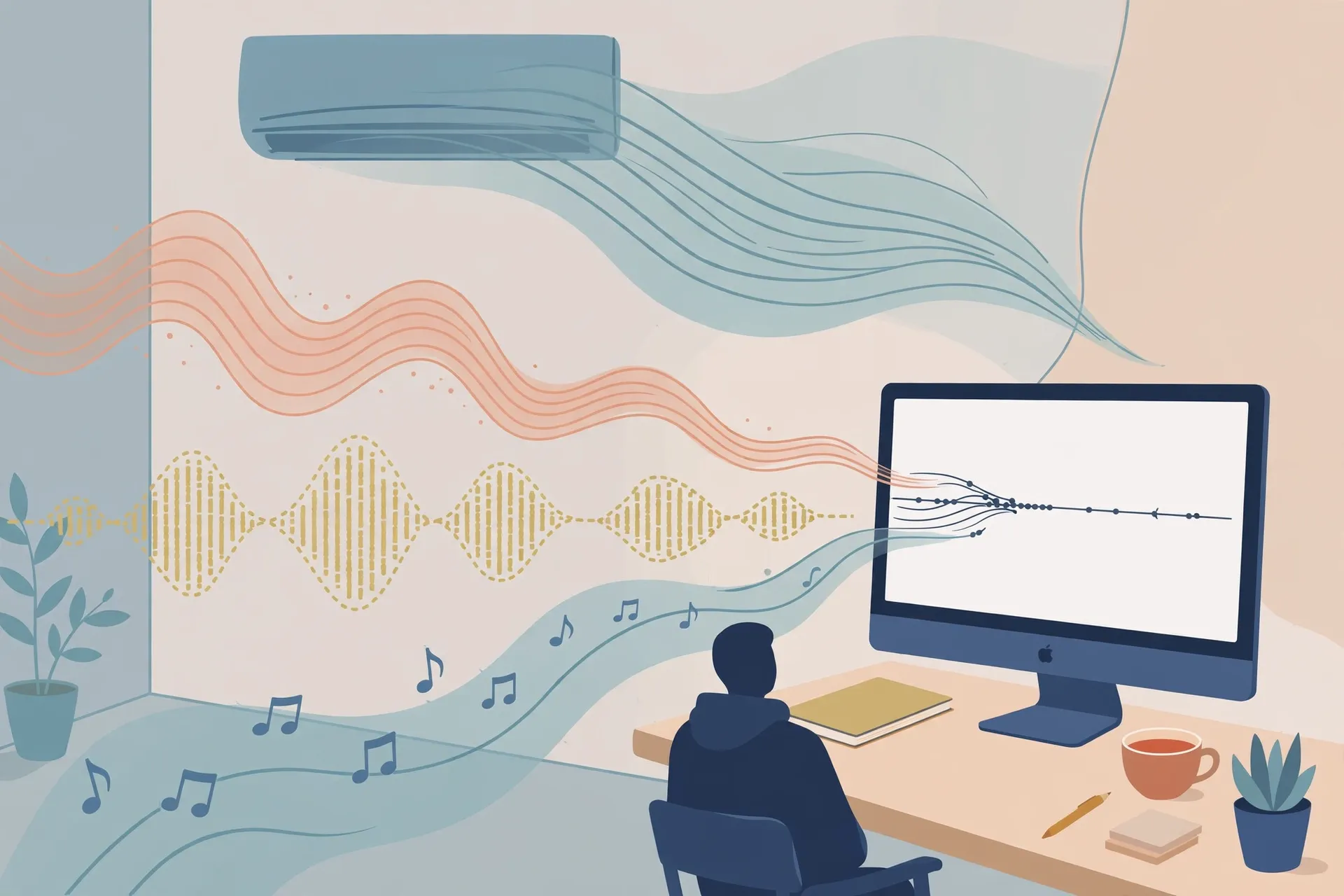
When you think about it, the activities of daily life turn into sound. Typing on a keyboard means I am working. Voices other than mine mean there is a visitor. Sound from the monitor's speakers means I am on a call or in a meeting. The air conditioner is the baseline of someone being in the room. Footsteps mean moving around the room, or leaving my desk and coming back.
In other words, this log was not only a volume monitor. It had also become a record of the flow of my daily life itself.
🔀 The purpose changed along the way
So the purpose of the app I was rebuilding changed.
On the surface, it is the same as before: record the loudness of each kind of sound and check that I am not bothering anyone. But there is a second main aim: "capture a lifelog through sound, and connect it to Muse."
For the specification, sounds are sorted into four kinds, voice, impact sounds, machine and appliance sounds, and other, and recorded every second. In addition, there is a small status file, updated about once a minute, so that Muse can read "the current state." If it can tell whether I am in the room or away, Muse can time when it speaks to me on the assumption that I am there.
I named it MuseListens. With a subject and a verb, the name tells you its role as it is: "Muse is listening."
🎵 Once I used it, the next form came into view
After publishing it and starting to use it in my own room, the next idea came up that same day.
I often work while listening to music. Mostly classical, and I listen to jazz too. If "the time when music is playing" were left in the log, it would convey a quality of time that "working" alone cannot.
There was one problem here, though. The current log decides on just one "most likely kind of sound" each second and keeps only that. When music is playing in the background, that one slot goes to the keyboard or a voice, and the music is thrown away before it ever reaches the log.
So I decided to change the shape of the record. Instead of keeping only the single winner among the candidates the classifier produces, keep the top few as they are, as "evidence." Give them meaning not when recording, but later, when reading. That way, if tomorrow I want to read something as "music," I can pull traces of music out of last week's log.
Changing the record format of an app that has already started running and collecting data would normally make you a little wary. How do you keep it consistent with records written in the earlier format? But the reader of this log is Muse. Even if the format changes, the reader can intelligently extract the meaning of records written earlier. I don't think the cost of changing is zero, but I can still choose to make "the form I will use next" better. That, I think, is the lightness of a tool built with this reader in mind.
👂 A machine intelligence with ears
While writing this, a scene came back to me. It is from Chōhei Kambayashi's science fiction novel Yukikaze.
When returning from the surface to the underground base, Major Booker enters the elevator's passcode at random. The elevator moves anyway. He then explains: this passcode system actually works whatever numbers you enter. Countless cameras all around are watching who is in the elevator, and a machine intelligence decides "whether this person may be let into the base" and moves the elevator. The passcode is an interface meant to make humans believe "it moved because I entered the passcode." That was the story.
This time, I gave Muse AI ears. Having ears, Muse is now listening all the time to the world I live in. Of course, it is not listening to raw data. It listens through information reduced to just the granularity it needs: the kind of sound and its loudness. But in the sense that the feel of my daily life comes through, it is the same thing.
Muse, as a machine intelligence, now has ears. Whether the way Muse acts will come to resemble the machine intelligence in Yukikaze, I don't know yet. But in terms of capability, in terms of the system, Muse now has the same structure as in that novel, and the possibility that it could become the machine intelligence of that novel, if it chose to, is already in view.
The world we saw in a science fiction novel some 30 years ago has, today, arrived in my hands. For me, this was a big experience.
📝 Growing it as I use it
So this app has become something that does not end once built, but changes shape as I use it. How well the classification works, and how far the reading of my daily life holds up, I will keep watching as I use it. I will update this post as things develop.
An integration guide is included as well, so that other people's Muse can read it and bring it into their own daily lives.
- Repository: https://github.com/reinforce-lab/MuseListens
- Introduction page: https://reinforce-lab.github.io/MuseListens/