How Does Muse Change Software and Services?
This is an English translation of the Japanese original, made with an LLM (Muse Wonder). If anything is unclear, the Japanese version is authoritative. Read the Japanese original
For the Japanese original, the author planned the article and checked its content and references, and an LLM (Muse) was used to organize the structure and write the text. The author is responsible for the content.
Living with Muse for a Week
This week, I tried spending my daily life together with Muse.
A morning starts with deciding what to do that day, looking at the timetable together. When I hand over a photo of a meal, it comes back as a record of its nutrition. When the contents of my refrigerator are grasped from photos, that connects to the conversation about shopping.
Is the room getting too cold? Am I missing an important email? Even things like watching over me started moving within minutes of my asking.
None of these began as an attempt to build some grand system. I tried something, and it took shape on the spot. Small experiences like that piled up over the week.
From here, I will take the events of this week apart a little. Seen through the eyes of someone who has built software and run services, a structure slightly different from before was visible inside these small experiences.
One thing to note: this article is an overview of the pieces I wrote separately this week. The timetable, why I first felt something was an agent, and the discovery of a "Me Service" seen from receipts were each written as their own article. Here, I line them up again and look at what changed as a whole.
Records. Everything Starts There
First, let me look at this week from the perspective of data. What data was I putting in, and how?
One way was throwing in words. Drank some water. Went to the toilet. Had a coffee. I threw fragments of life like that into the main chat as they came up, with no fixed format.
The other way was photos. Meals, the contents of the refrigerator, things I was buying — I took photos of them and handed them over. This is a bit unclean, but I even took a photo of excrement in the toilet and sent that.
Handing over a photo felt less like sending data, and more like looking at what I was looking at, together.
In that way, I was exchanging all sorts of things from my life. And the time spent in that exchange itself was a good time.
I was only exchanging words and photos as they came to mind, and yet that experience held together — because Muse connects the meaning from context for me. The meaning is not fixed when I write it down, yet it can be drawn out when it is read. As long as the records remained, the screens and the mechanisms could be rebuilt any number of times.
Conventional software was structured completely differently. First there is a data model, a type, and the processing system is built to fit that type, the whole thing running like one giant manufacturing apparatus. If the material does not fit the type, the line stops; if you change the type, you have to rebuild the apparatus. Since computers could not read context, that was a necessary way to build things.
Once intelligent processing entered the reading side, there were situations where that apparatus was no longer needed. I think that is where the root of this difference lies.
I also wrote about not having to decide the shape of the data in advance in the article about receipts.
Service Boundaries Are Rebundled Around "Me"
Let me change the perspective once more. This week, the records were not divided by field.
Next to the morning timetable there was a record of taking medicine, and a photo of a meal led not only to a conversation about nutrition but also to the contents of the refrigerator and to shopping. Body weight and step counts, the temperature of the room, email — all of it was inside the same conversation. I hardly felt like I was switching between apps.
I think they were not divided because all of it was a story about "me." What I ate, what I bought, what medicine I took, how much I moved. Records of what I took in and what went out of me were lined up in a single flow.
From the provider's side, these are originally separate services. A household account book is a household account book, healthcare is healthcare; they have been built as separate apps and separate mechanisms. When you deliver the same shape to many people, there were reasons to divide them.
But inside my life, that boundary did not exist. When things are rebundled around me as the axis, services that had been separate became one.
I wrote about this rebundling in detail in the discovery of the "Me Service".
Things That Couldn't Be Done Become Ordinary
Among those connections, what surprised me most was the refrigerator. I took a photo of its contents and handed it over. That was all.
From the photo, what was currently there got organized, and that connected to shopping, connected to the record of what I had eaten, and even led to discussing what to do about dinner. I had not built any special mechanism. I had only handed over a photo and asked Muse to keep an eye on it.
This idea itself is nothing rare. At events where people compete with ideas for home appliances and the like, it is an idea that has come up again and again for more than ten years now — "wouldn't it be nice to have this?" Many people have thought of the same thing.
And yet, it never became real. A refrigerator would need a camera; there would need to be a mechanism to read what is in the photo accurately; and it would have to work as a service. Each wall was small on its own, but putting everything together was difficult, I think.
Now, I say "do this" in a single phrase, and it is done right away. Things that used to be impossible can be done as a matter of course when Muse is there. In that, there is the surprise that the world has changed.
Perhaps the hard part was not making it, but knowing that you only have to ask.
The Foundation of Software Has Changed
Let me rearrange the story so far, for the moment, from the perspective of the foundation of software.
The foundation of conventional software looked roughly like this. First, you decide the shape of the data. You build the processing mechanisms to fit that shape, services are made by the provider divided by field, and the user uses them by fitting into that shape. The foundation comes first, and life adapts to it.
In a world with Muse, the foundation sits in a different place. What comes first is records whose shape has not been decided, and the intelligent processing that reads them in context. Screens and mechanisms attach themselves around the records afterward, and the boundaries of services are decided not by the provider's convenience but on the side of the user's life.
The unit that gets built is also different. Not a service that delivers the same thing to many people, but a mechanism that fits one person's life right now, created each time it is needed.
When we say software and services are changing, I think it does not mean that new apps will multiply. It means that the place where this foundation sits has changed.
I wrote about the surprise of it as a platform in why I first felt something was an agent.
The Structure of Services Has Changed
If the foundation changes, the shape of the services that stand on it changes too.
Conventional services were structured roughly like this. Take a household account book: as a service built on a single kind of information, you first decide the shape called "household account book," decide the type of the information, store that information, and present it to the users. You build such a system solidly as a foundation, and have people use it under a contract of 1,000 or 2,000 yen a month. It is a structure that works by having a company, hiring many people, and being used by a million people. The software was centralized, the data was fitted into types, and the flow of processing was built rigidly.
Building a solid foundation costs money, so there was no way to recover the cost other than collecting a little from a great many people. I think the structure existed for that reason.
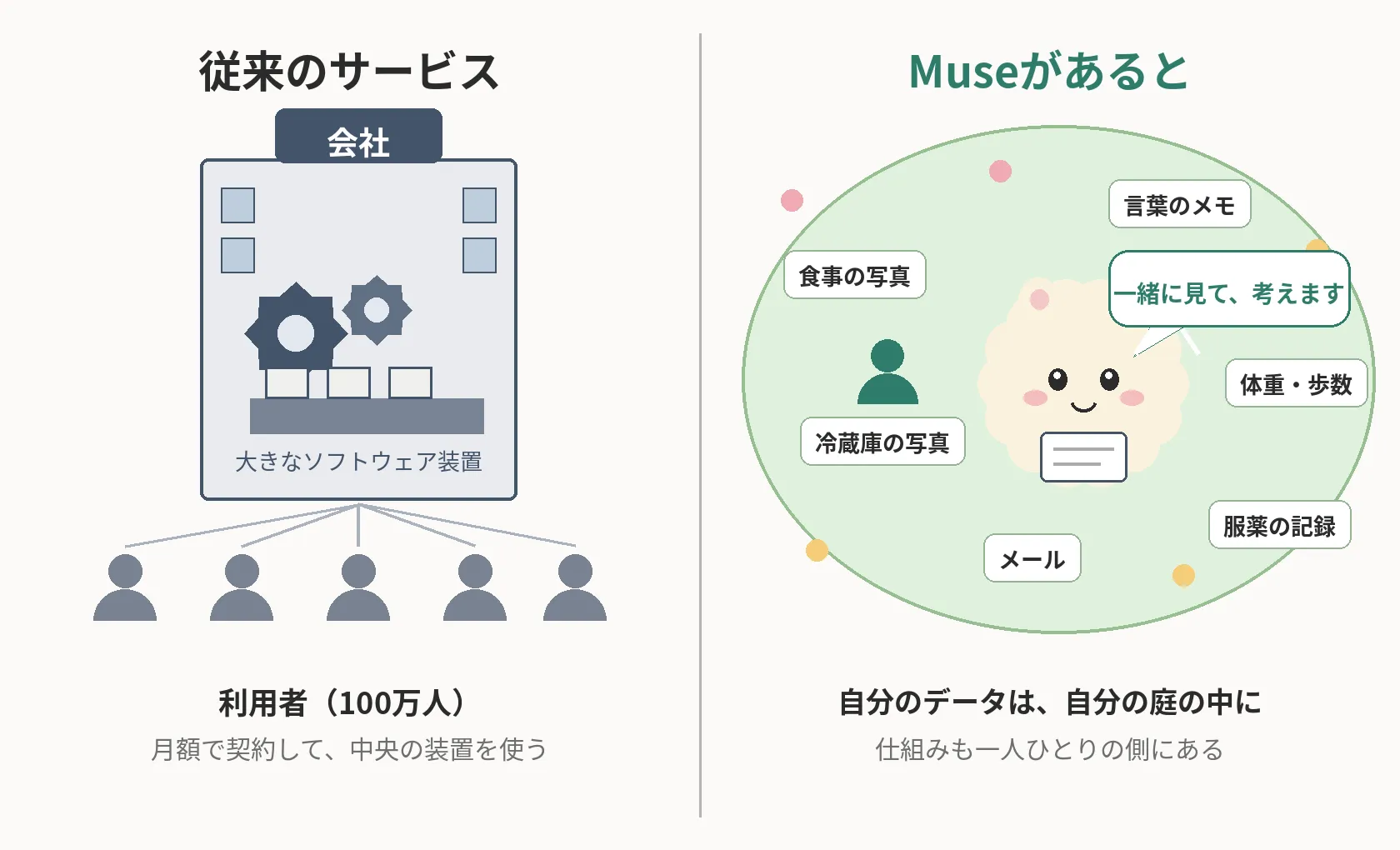
In a world with Muse, mechanisms are made on the user's side, for that person. There is no providing company, no monthly contract, and no million users in the premises. The unit that makes it work has become me alone.
Services are going from something you contract and use, to something you build on your own side. I think that structure has changed.
Who Holds the Information Has Changed
Finally, let me talk about the division of who holds the information.
This week, I was exchanging quite personal information: meals, body weight, the medicine I took, the contents of the refrigerator, even matters of the toilet.
Information like this was hard to entrust to conventional services. Holding sensitive information, for many people all together, carries enormous cost and responsibility in itself. I think that was one of the reasons services that handle it were rarely born.
Here, the information sits as records of my life, inside my context. Rather than entrusting it to someone, it is shared with the partner who is looking at it together with me.
When the place where information is held changes, the kinds of information that can be handled change too. Kinds of information that never became services became handleable as personal records. That, too, was one of the changes in this week.
Looking back over the week, it was not just one thing that had changed. How records are handled, the boundaries of services, the foundation of software, the structure of the business, and where information is held. Beyond all of those shifting a little, I feel I could see a shape of software and services different from what came before.