Chapter 1 of a Book to Read Before Building BLE Products Is Now Public
This is an English translation of the Japanese original, made with an LLM (Claude Opus 5.5). If anything is unclear, the Japanese version is authoritative. Read the Japanese original
For the Japanese original, the author planned the article and checked its content and references, and an LLM (Claude Code) was used to organize the structure and write the text. The author is responsible for the content.
When you set out to build a product that uses BLE (Bluetooth Low Energy), each person involved sees something different.
- The product planner pictures the experience of operating a device from a smartphone
- The app developer sees events delivered through the OS APIs
- The firmware developer sees the state inside the device and the values it exposes to the outside
Each of them understands BLE from their own side. Yet it is often only when the device and the app are connected and run together that people notice the integration is not what they expected. The closer to the end of development, the harder it is to fix.
The technical book I am writing in Japanese, Bluetooth Low Energy Kaihatsu Jissen (Bluetooth Low Energy Development in Practice), aims to reduce this mismatch. It explains not only how to use SDKs and APIs, but also what is actually communicated over BLE and what happens where. The goal is for firmware developers, app developers, product planners and hobbyists to speak the same language and be able to isolate problems.
I have published its Chapter 1, "What Is BLE? Let's Get It Running First", early as a draft. You can read it for free as a PDF and an EPUB.
- Chapter 1 early release (GitHub Release): https://github.com/reinforce-lab/ble-in-action/releases/tag/ch1-preview-2026-11
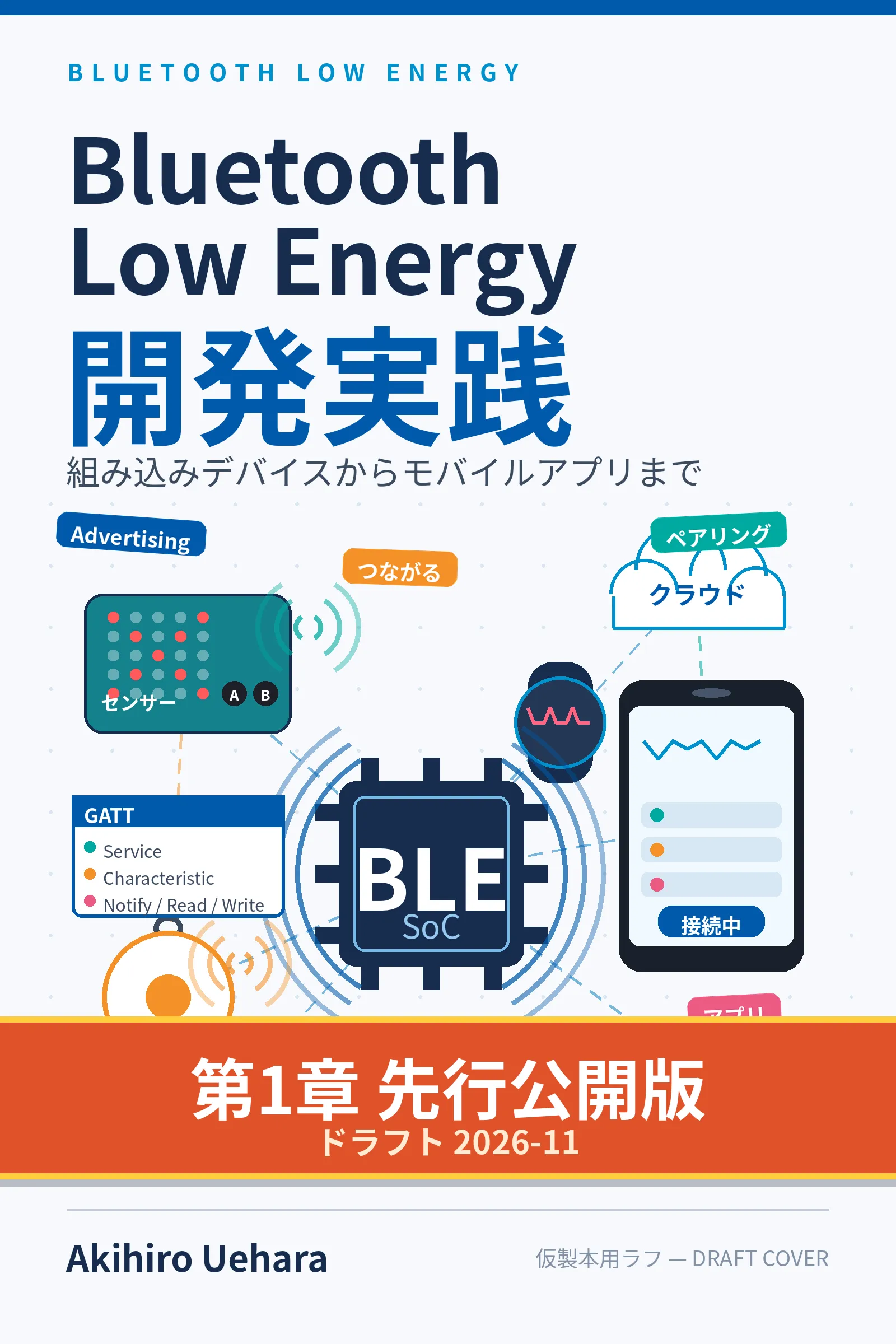
What Chapter 1 covers
Chapter 1 gives an overall view of what BLE can do and what you decide when building a product. It involves no programming.
Learning the communication behind it while running it
You connect a micro:bit and an iPhone over BLE, and check that pressing a button changes what the app shows, and that a pattern drawn in the app appears on the micro:bit's LEDs.
Then the chapter explains the communication that was happening behind what you just saw, divided into four scenes:
- Finding the other party (advertising)
- Connecting
- Protecting the communication (pairing and bonding)
- Exchanging data (GATT)
Finally, you connect to the micro:bit with "nRF Connect", an app for BLE development, and read and write the values the device exposes (Services and Characteristics) directly. Before building an app, you become able to check with your own eyes what the device exposes.
The integration between a device and an app becomes clear when you think of GATT as the boundary. The book compares GATT to the control panel of a claw machine. The player does not need to know the inside of the machine; they move it through the panel's buttons and display. In the same way, an app and a device can work together without knowing each other's internals, as long as they share the items and meanings of the "control panel" called GATT.
Learning what kinds of products use BLE
Even with the same BLE, products take many forms. Chapter 1 organizes the ways BLE is used by who shares the agreements (profiles).
- Standard profiles: products such as BLE keyboards, where devices from different makers and the OS work together as they are
- Products built together with a dedicated app: the device, the app and the cloud service behind it are built as one product
- BLE built into platforms: BLE-MIDI, detection networks for lost-item tags, and initial setup in Matter, the smart home standard
It also follows how the Bluetooth 4 to 6 core specification updates have expanded what BLE can do: choices of data rate and range, broadcasting without connecting, and measuring direction and distance. You can get a sense of which kind of use the product you have in mind is closest to.
Learning what to decide when building a product
Lastly, the chapter covers how to proceed with development that uses BLE.
- From the use case you want to build, extract the communication range, the amount of data and whether a network is needed, and judge whether BLE fits
- Learn how the development flow differs between building something for your own use and making a product as a business (including compliance with radio regulations and product registration with the Bluetooth SIG)
- Instead of connecting the device and the app only after building each separately, connect working pieces early and check them
- Map the user's experience of starting to use the device, continuing to use it and finishing using it to BLE technologies such as advertising, connection intervals and pairing, and put it together as a specification
Who gets what
Product planners get the full picture of the experiences that are easy to build with BLE and the decisions that must be made. You will get a sense of what to check with developers and contractors.
App developers learn what happens between the app and the device behind the OS APIs. You will see what to check on the device side.
Firmware developers can reconsider how the Services and Characteristics they expose connect to the app and the product experience. You can organize the agreements you need to communicate to the app side.
People who want to try BLE can start by checking how BLE works at hand with just a micro:bit and a smartphone. Even without the hardware, you can follow the steps in videos on the official micro:bit site.
Published as a draft
Chapter 1 is a draft in progress. The parts printed in gray in the PDF and marked [to be checked later] will be checked or expanded. References to chapters not yet published do not display correctly. The title, cover and typesetting are also provisional.
If you find errors, parts that were hard to understand, or topics you would like covered, please let me know through a GitHub Issue.
After the book is finished, I plan to keep the text public on GitHub and also offer paperback and Kindle editions through Amazon KDP. The text is published under CC BY-NC-ND 4.0, and referencing it in development that uses LLMs, RAG and similar tools is allowed for both commercial and non-commercial use. For the detailed conditions, see LICENSE-MANUSCRIPT.md in the repository.