Does a Lower Monthly Fee Mean Cheaper Charging? Comparing ZESP3 and eMP Light for My Own Use
This is an English translation of the Japanese original, made with an LLM (Claude Opus 5.5). If anything is unclear, the Japanese version is authoritative. Read the Japanese original
For the Japanese original, the author decided the experiences and structure and checked the content, and an LLM (Muse) was used to organize the structure and write the text. The author is responsible for the content.
🔌 When a new plan comes out, I tend to look only at the monthly fee
e-Mobility Power (eMP) announced new charging plans. They start on December 1, 2026, and add a new "Light" plan at 1,650 yen per month.
What I use now is Nissan's ZESP3 Premium 100, at 4,400 yen per month. By the numbers alone, Light is less than 40% of that.
But I had a feeling that charging plans cannot be compared by the monthly fee alone. How many minutes are included and how much each extra minute costs make the plans completely different in shape. So I decided to apply my own usage to two patterns and calculate which one fits.
First, let me note what is good about Light apart from the price. CHAdeMO chargers have different apps and QR code procedures for each operator, and I sometimes fumble on site. Being able to pay just by tapping a charging card makes things much easier by itself. For that ease of use alone, I think 1,650 yen a month is well worth it. So if Light turns out to be more expensive in some situations in the calculations below, it does not mean "Light is bad". It is a question of whether the price difference balances that ease of use.
📌 The conclusion first
Which plan is better depends on how you use it:
- Most months you do not charge away from home / less than 80 minutes of rapid charging a month → eMP Light. The monthly fee is low, it is even better if you mostly use ordinary roads, and the ease of card payment alone is worth 1,650 yen a month
- Two or more long trips a month and more than 100 minutes of rapid charging → ZESP3 Premium 100. Within the included allowance the price does not change, and the 600-minute normal charging allowance also helps. In my case, this was the answer
- 250 minutes or more of rapid charging a month at high-power chargers on expressways → eMP Premium becomes one of the cheapest
- You can leave the car at a 6 kW normal charger for long periods during the day → ENECHANGE Passport (a flat 2,980 yen per 30 days) is the cheapest
- You can charge at home → household electricity is the main cost, and a card at about the Light level is often enough as insurance for charging away from home
The graphs in the article check one by one why it splits this way.
📋 The two plans compared
Prices include tax, and are based on each service's published materials.
ZESP3 Premium 100 (my current plan)
- 4,400 yen per month
- Includes 100 minutes of rapid charging and 600 minutes of normal charging per month (unused rapid minutes carry over to the next month)
- Overage: rapid 44 yen per minute, normal 3.3 yen per minute
Price details are on Nissan's official page (ZESP3).
It is a "flat rate up to a certain amount, then pay per use" model.
eMP Light (new)
- 1,650 yen per month, nothing included
- Rapid charging is billed by time, and the rate depends on two things: "location" and "charger output" (table below)
- Normal charging is 4.4 yen per minute
The rapid charging rates (yen per minute) are:
| 50 kW or less | 50–100 kW | Over 100 kW | |
|---|---|---|---|
| Ordinary roads | 33.0 yen/min | 46.2 yen/min | 59.4 yen/min |
| Expressways | 46.2 yen/min | 59.4 yen/min | 72.6 yen/min |
The important point here is that the "output" that sets the rate is not the power actually flowing, but the charger's rating (the maximum output per connector). For the same 30 minutes, a 50 kW-class charger on an ordinary road costs 990 yen, while a 150 kW-class charger on an expressway costs 2,178 yen, more than twice as much.
And the current CHAdeMO adapter for Teslas is limited to 50 kW, so even when connected to a high-power charger on an expressway, the charging speed stays at the 50 kW class. Yet the rate is calculated in the highest band. This creates the worst-value combination with Light: "50 kW-class speed at a 150 kW-class rate". That is why the expressway high-power band has a steep slope in the graphs later.
In exchange for the low monthly fee, it is a "pay per use" model where what you use is added directly. eMP also has a "Premium" plan at 4,180 yen per month plus a flat 27.5 yen per minute for rapid charging, which I included in the graphs for reference. The Premium and Light price tables can be compared side by side on eMP's official page (new charging plans).
Let me also state my assumptions. My car is a Tesla Model Y, I have no charging equipment at home, and I do all my charging outside. In the Tesla app statistics (past 12 months), I drove 7,955 km, charged 1,679 kWh in total, and of that, "Other", which is almost entirely via ZESP3/eMP, was 1,393 kWh (83%). That averages about 116 kWh a month. However, it varies a lot from month to month: the largest month was 363 kWh, and some months I hardly charged at all.
🧭 How I set up the patterns
The comparison is split by usage pattern.
- Pattern A: you can go and come back on a full charge, so you do not charge away from home
- Pattern B: a long trip where you cannot get back without charging along the way
For rapid charging, I first calculate on the premise of "the current 50 kW adapter", then separately look at "how things change if a 130 kW adapter can be used".
🏠 Pattern A: no charging away from home
If you leave on a full charge and can come straight back, there is no rapid charging on the road. In this case, what you compare between card plans is not rapid charging but how you top up before and after the trip.
For example, if you top up a 400 km round trip (about 84 kWh at my actual efficiency of about 21.1 kWh/100 km) with 6 kW normal charging, it takes about 844 minutes. The monthly cost:
- ZESP3: about 5,210 yen (the amount beyond the 600-minute normal allowance is added)
- Light: about 5,360 yen (844 minutes × 4.4 yen + monthly fee)
They are nearly even. Comparing normal charging alone as a graph looks like this. The horizontal axis is normal charging time (minutes per month), and the vertical axis is the monthly cost.
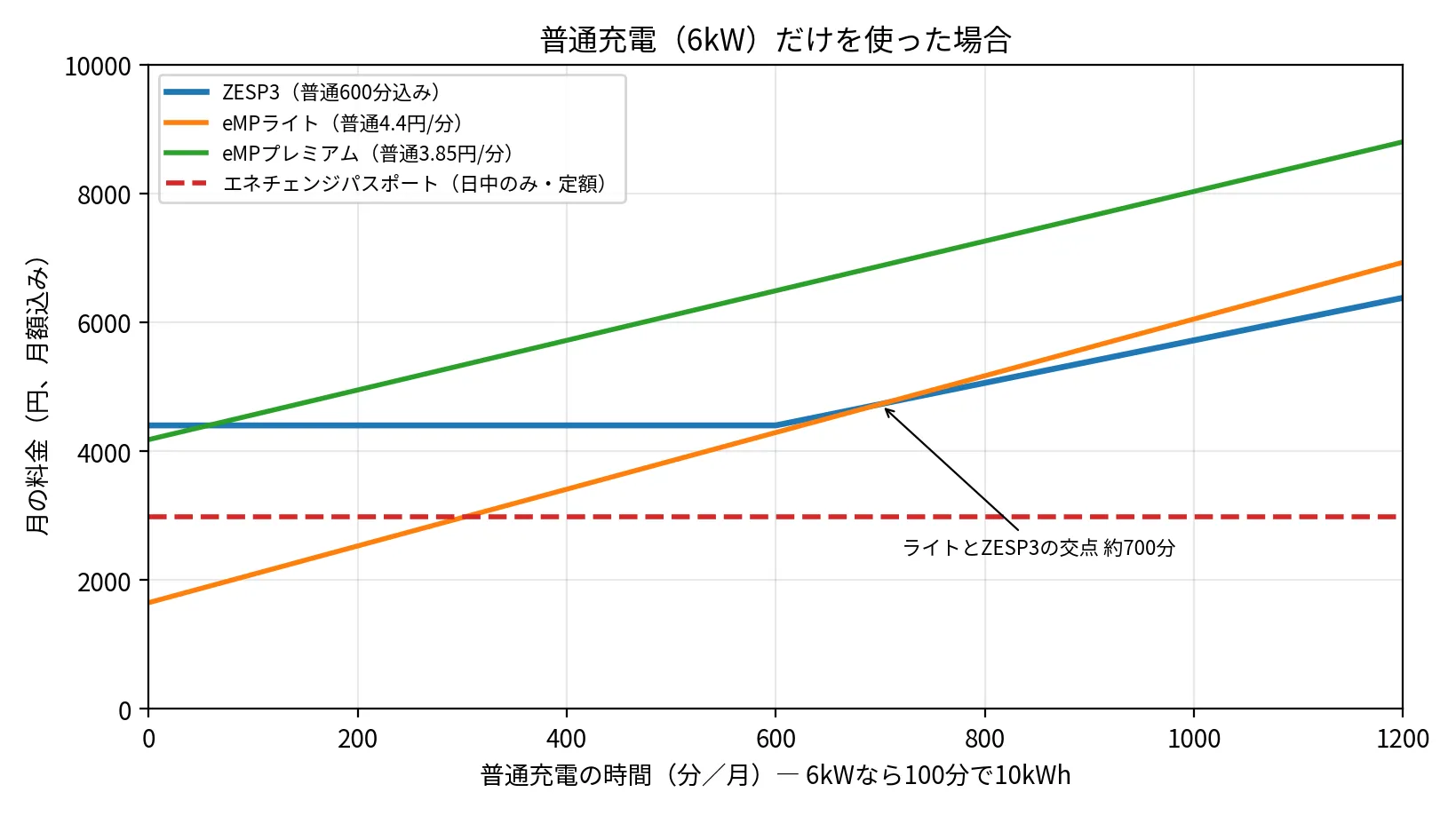
For normal charging, Light and ZESP3 cross at about 700 minutes. Up to 700 minutes Light is cheaper; beyond that, ZESP3, with its 600 included minutes and 3.3 yen per minute overage, is cheaper. 700 minutes at 6 kW is 70 kWh, about 330 km at my efficiency.
There are also ways to top up other than cards. A home outlet costs only household electricity (about 31 yen per kWh as a guide), and if you can leave the car at a 6 kW charger for long periods during the day, there is ENECHANGE's flat-rate Passport (2,980 yen per 30 days, valid 7:00 to 16:00). That is why it is shown as a dashed line in the graph; for usage with a lot of normal charging, this flat rate comes out lowest.
🛣️ Pattern B: you cannot get back without charging (50 kW adapter)
This is closer to my daily life. Let's take a 600 km round trip.
Range differs by model. Of the two cars I have driven, the Model Y RWD (2023) is rated at 507 km and the Model Y Long Range (2025) at 635 km (both published single-charge range figures). Assuming real-world range is 80% of that, the RWD can go about 406 km without charging and the Long Range about 508 km.
CHAdeMO rapid charging is often limited to 30 minutes per session, and 30 minutes is said to add up to 125 km, so the number of top-ups needed for a 600 km round trip is two for the RWD (60 minutes of rapid charging) and one for the Long Range (30 minutes).
There is one more thing here: the state of charge at departure. The Long Range battery is a ternary (NCM-type) battery, and an 80% daily limit is recommended. Leaving at 80% lowers the real-world estimate to about 406 km, and two rapid charges are needed. Charging to 100% the day before makes one enough. In other words, "charging to 100% the day before" is worth 30 minutes of rapid charging on the road. However, staying at 100% is not recommended because of battery degradation, so this applies only to the day before a long trip. The RWD battery, on the other hand, is lithium iron phosphate (LFP), for which charging to 100% is recommended. The RWD's roughly 406 km is a "full charge without holding back" figure, so there is no trade-off at all. That the Long Range at 80% and the RWD at 100% both come out at about 406 km of real-world range was an interesting coincidence when I lined them up.
Now, the cost. With a 50 kW-class charger on the expressway and one long trip a month:
- Long Range (30 minutes rapid): ZESP3 4,400 yen (within allowance) / Light about 3,040 yen
- RWD (60 minutes rapid): ZESP3 4,400 yen (within allowance) / Light about 4,420 yen
With one trip a month, Light is cheaper or about the same. But with two trips a month, rapid charging becomes 60 minutes for the Long Range and 120 minutes for the RWD.
- Long Range (60 minutes rapid): ZESP3 4,400 yen / Light about 4,420 yen
- RWD (120 minutes rapid): ZESP3 about 5,280 yen / Light about 7,190 yen
For the RWD, the order flips. The dividing line is "whether rapid charging exceeds 100 minutes", and the shorter a car's range, the sooner it exceeds it.
The overall shape is easier to see in a graph. The horizontal axis is the amount charged by rapid charging away from home (kWh per month), and the vertical axis is the monthly cost. To convert time-based billing into kWh, I assume an average of 40 kW (a guide based on a 50 kW-class charger and the current 50 kW-limited CHAdeMO adapter).
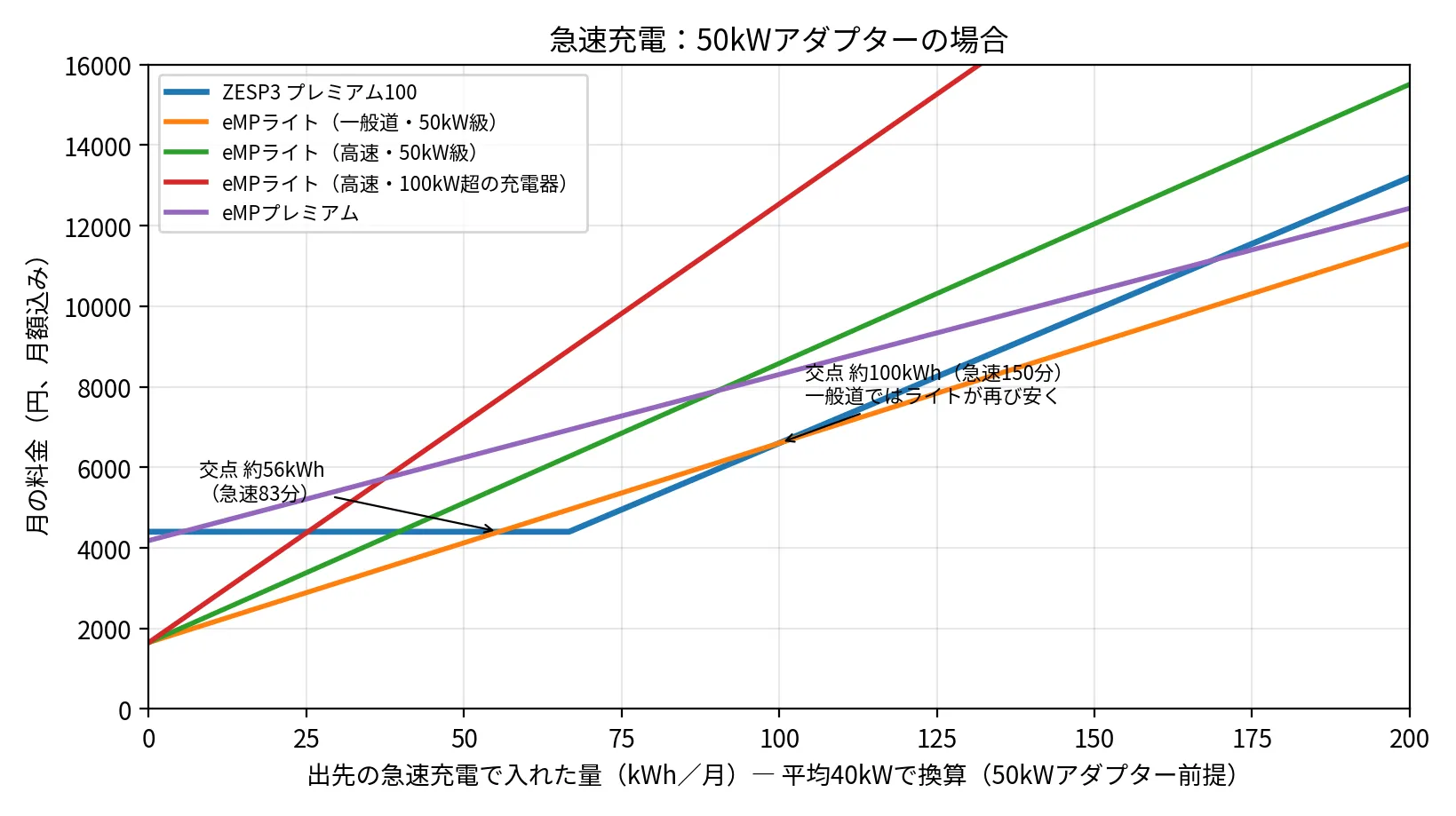
Three things can be read from it.
- While the amount is small, Light is cheaper. On ordinary roads with a 50 kW-class charger, Light stays below up to about 56 kWh (83 minutes of rapid charging)
- ZESP3 is flat up to 100 minutes (about 67 kWh in this conversion). Within the included allowance, using more does not change the price. Instead, once past the allowance, it rises with a slope of 44 yen per minute
- Light on ordinary roads has a second crossing point. Because ZESP3 starts adding overage charges, beyond about 100 kWh (150 minutes of rapid charging), Light on ordinary roads with a 50 kW-class charger becomes cheaper again. At expressway rates, however, this catch-up does not happen. The band for chargers over 100 kW (72.6 yen per minute) has an especially steep slope: with the current adapter, the amount you get is limited to 50 kW while only the rate is high, which is a poor-value combination
The size of the benefit can also be seen in the "space between the lines" of the graph. At about 50 kWh a month on ordinary roads, the difference between Light and ZESP3 is around 1,000 yen a month. The more you charge, mostly on expressways, the wider the gap opens in the opposite direction.
⚡ The switch: if a 130 kW adapter could be used
So far the premise was "the adapter is limited to 50 kW". Tesla has announced that it plans to release a new rapid charging adapter (CHAdeMO) supporting 130 kW in January 2027 (planned at 95,900 yen; reports say it is for buyers of the new Model 3/Model Y, and it is unconfirmed whether existing owners can buy it).
If it could be used and charged at an average of 90 kW at high-power chargers on expressways, the time to put in the same amount would be less than half. In a world of time-based billing, this means the slope of every plan becomes gentler. As a graph:
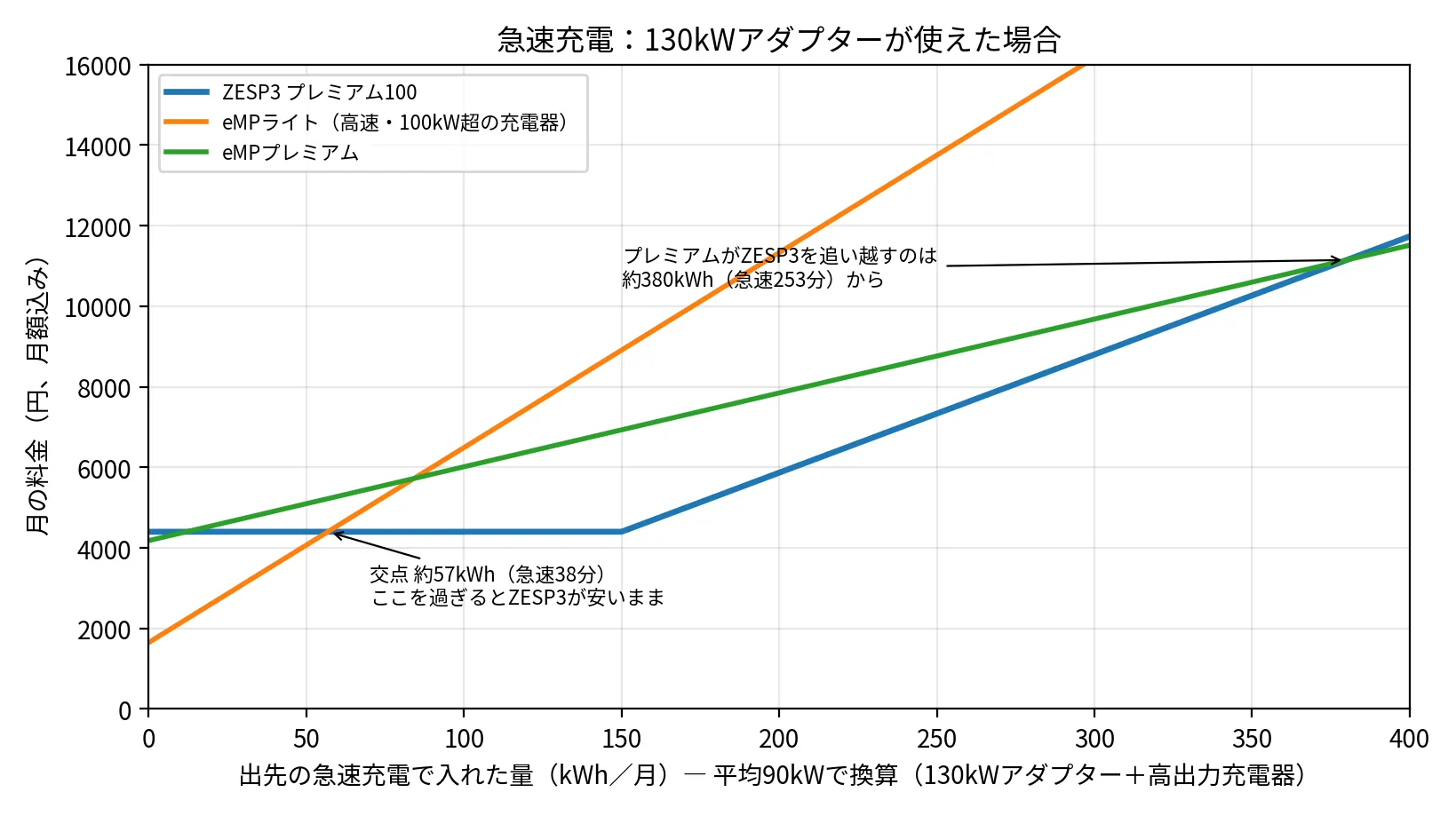
Mainly two things change.
- ZESP3's flat section extends to about 150 kWh in amount. Because more is charged in 100 minutes, the effective "size" of the included allowance more than doubles. In the expressway high-power band, Light stays cheaper than ZESP3 only up to about 57 kWh (38 minutes of rapid charging); beyond that, ZESP3 remains cheaper
- Premium's slope becomes gentler. The flat 27.5 yen per minute gets cheaper per kWh the faster you charge. At an average of 90 kW, it is effectively about 18 yen per kWh. However, it overtakes ZESP3 in monthly total only from about 380 kWh (253 minutes of rapid charging), so unless your usage reaches that amount, it still does not get there in total
In other words, higher power does not eliminate "the disadvantage of time-based billing"; it works in the direction of increasing the effective size of the flat-rate allowance. In my usage (rapid charging in the range of tens to a little over a hundred kWh a month), the reading of this graph is that even if the 130 kW adapter arrives, the order shifts further toward ZESP3.
Thinking about why ZESP3 looks this cheap, I suspect its time-based rates were designed in an era when rapid chargers were almost all 50 kW-class. A rate of 44 yen per minute was probably set with a sense of "effectively 50-something yen per kWh" in that era, and as chargers and adapters have become more powerful, the pricing has carried over unchanged and quietly become cheaper. eMP's new plans changing rates by output band is the opposite: probably a revision to fit the era of high power.
That means if ZESP3 also revises its pricing to fit higher power in the future, the story will change. If ZESP3's slope rises in the 130 kW graph, what remains is the difference in monthly fees, and Light, with its lower minimum monthly fee, should benefit people who do not use much. The current order may be resting on a generational difference in pricing schemes.
There are also more options besides cards: Tesla Superchargers (no monthly fee; prices per location shown in the app), FLASH with kWh billing at 44 yen per kWh, per-minute services with no monthly fee, and so on. Whether such chargers are nearby also changes the premises of choosing a plan. But since the subject of this article is comparing the two card plans, I only mention them here.
✍️ My case, and your usage
In my case, it works out like this.
My actual monthly average of "Other" is about 116 kWh, which corresponds to about 174 minutes of rapid charging at an average of 40 kW. On the graph, I am well past ZESP3's flat section. Still, the conclusion is "keep ZESP3" because the 600-minute normal charging allowance and the fact that rapid charging rates do not depend on the output band make the difference. In terms of money alone, it is a difference of a few hundred to a few thousand yen a month, but ZESP3 cannot be newly joined by anyone other than Nissan EV owners, and in a case like mine, once I cancel, I most likely cannot come back. Weighed against that, the decision leans toward the cautious side.
But this is only about my year, my amounts and my places. What I most want to say in this article is that the answer differs greatly from person to person. How many long trips you take a month, which car with which range, whether the chargers you often use are on ordinary roads or expressways, whether you have a place to leave the car on normal charging during the day. These decide where on the graph you are.
So for your own case, asking with your own numbers is the quickest. Now, if you give an LLM your usage, it will do the kind of calculation this article did on the spot, with your conditions. For example, you could ask like this:
Please compare charging plans for how I use my EV.
- I drive about ○ km a month and charge about ○ kWh
- I use rapid charging ○ times a month, about ○ minutes each. Mostly at (expressway service areas / ordinary roads)
- I use about ○ minutes of normal charging a month (I don't use it)
- I (can / cannot) charge at home The candidates are ZESP3 Premium 100 (4,400 yen per month, includes 100 minutes of rapid and 600 minutes of normal charging; overage is 44 yen/min rapid and 3.3 yen/min normal) and e-Mobility Power Light (1,650 yen per month; rapid charging is 33.0–59.4 yen/min on ordinary roads and 46.2–72.6 yen/min on expressways; normal 4.4 yen/min). Which is cheaper, and by roughly how many yen?
You can pick up the numbers from your charging service's usage statements or your car app's charging statistics. I leave this article as one example of how it turned out in my case.
Sources and notes
- e-Mobility Power new pricing plans (starting December 1, 2026): special page (https://www.e-mobipower.co.jp/charging-plan-202612) and the press release dated November 24, 2026. Premium: 4,180 yen per month, rapid flat 27.5 yen/min, normal 3.85 yen/min; Light: 1,650 yen per month, rapid billed by time by location and output band, normal 4.4 yen/min; others as stated in the text.
- ZESP3 Premium 100: published prices on Nissan's official page (https://www.nissan.co.jp/EV/CHARGE_SUPPORT/ZESP3/). 4,400 yen per month, includes 100 minutes of rapid and 600 minutes of normal charging; overage 44 yen/min rapid and 3.3 yen/min normal; unused rapid minutes carry over to the next month.
- Tesla app charging statistics (past 12 months, checked on 2026-11-25): 7,955 km driven, 1,679 kWh charged in total, 286 kWh at Superchargers, 1,393 kWh Other. The spending shown in the app is an estimate based on configured unit prices, so it is not used in the calculations in the text.
- Model Y range: the RWD (2023) 507 km is the WLTC figure approved by Japan's Ministry of Land, Infrastructure, Transport and Tourism; the Long Range (2025) 635 km is the figure published at launch.
- CHAdeMO rapid charging: many locations limit a session to 30 minutes, and Tesla's support page says 30 minutes adds up to 125 km and that the conventional CHAdeMO adapter is limited to a maximum of 50 kW.
- Recommended charge limits: Tesla's owner's manual advises keeping vehicles whose daily charge limit is 80% at about 80% and reserving 100% for long trips, and for vehicles with lithium iron phosphate (LFP) batteries, setting the charge limit to 100% and charging to 100% at least once a week.
- Battery chemistry: Tesla does not officially disclose it. The Model Y for Japan is made at the Shanghai factory, and the Long Range cells have been reported, based on Chinese certification documents and other sources, to be LG ternary lithium (NCM), so the text says "ternary (NCM-type)". The RWD is lithium iron phosphate (LFP).
- ENECHANGE Passport: based on ENECHANGE's published materials and terms of use (revised March 10, 2025). 2,980 yen per 30 days; available 7:00 to 16:00; applies to 6 kW normal charging spots marked "Enepass eligible" in the app.
- FLASH: based on Tenfields Factory's published materials. Standard price 44 yen per kWh (tax included), NACS compatible, no monthly fee.
- New rapid charging adapter (CHAdeMO): based on reports of Tesla Japan's announcement on October 23, 2026. 130 kW support, 95,900 yen, planned for release in January 2027. Eligibility was unconfirmed at the time of writing.
- The guide price of 31 yen per kWh for electricity is the guideline calculated by the Japan Fair Trade Council for Household Electric Appliances.
- All prices in the text include tax. "Real-world range is 80% of WLTC", "rapid charging averages 40 kW/90 kW" and "range scales in proportion to SOC" are assumptions for calculation, not measurements. The graphs were calculated from each plan's price table under these assumptions, and the images are included in the article folder.